Crawford to White, Sept. 17, 1900
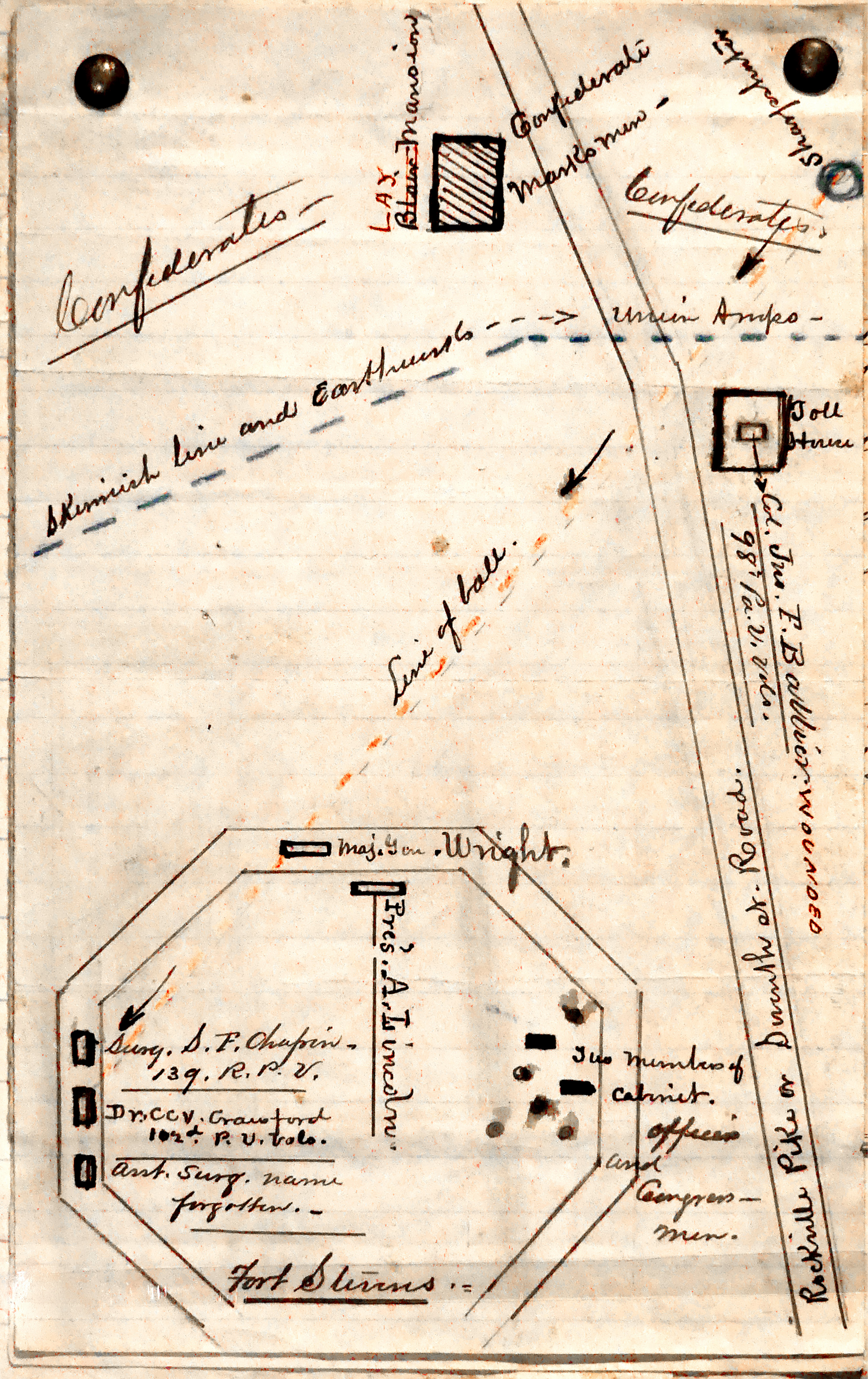
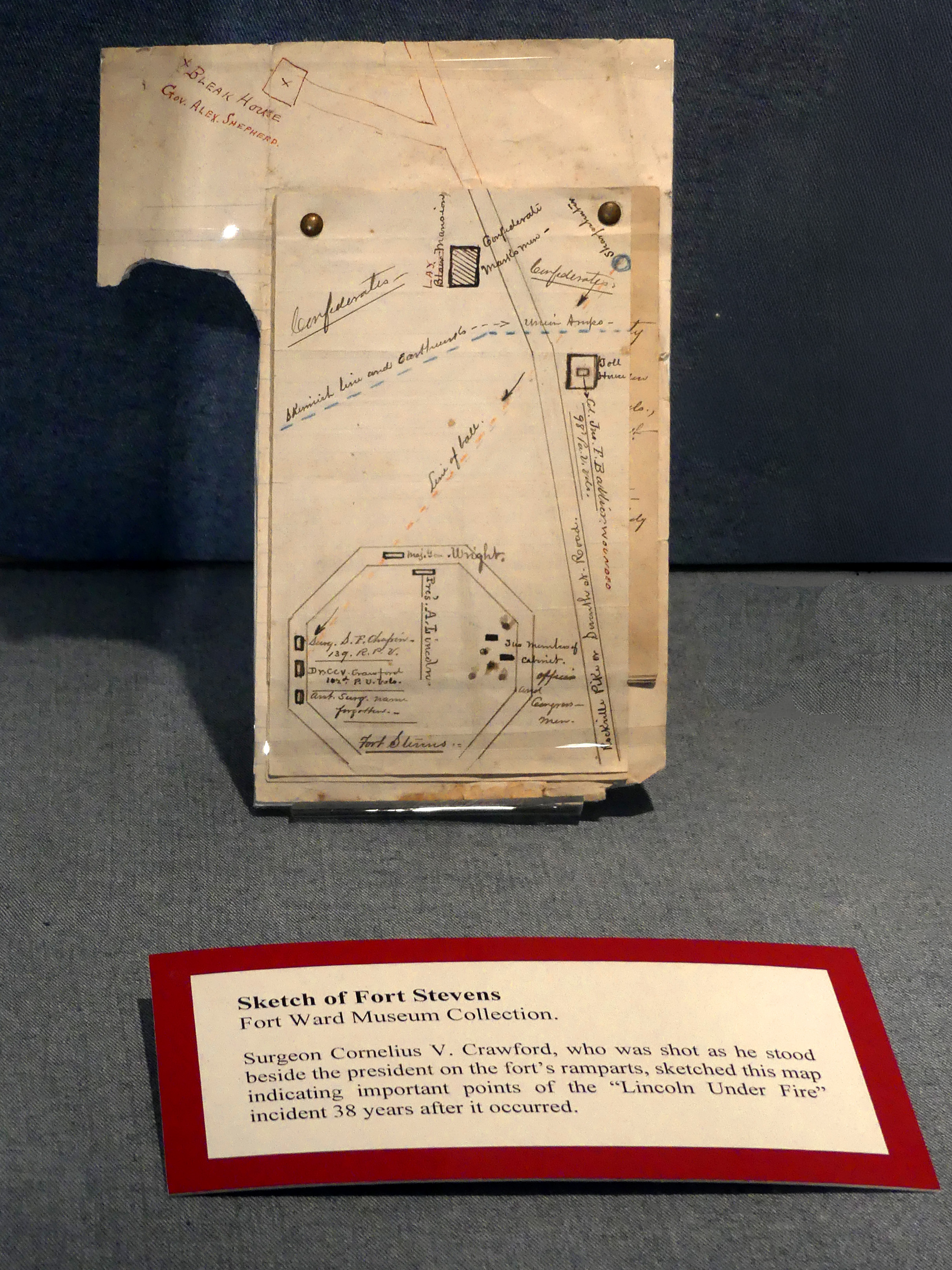
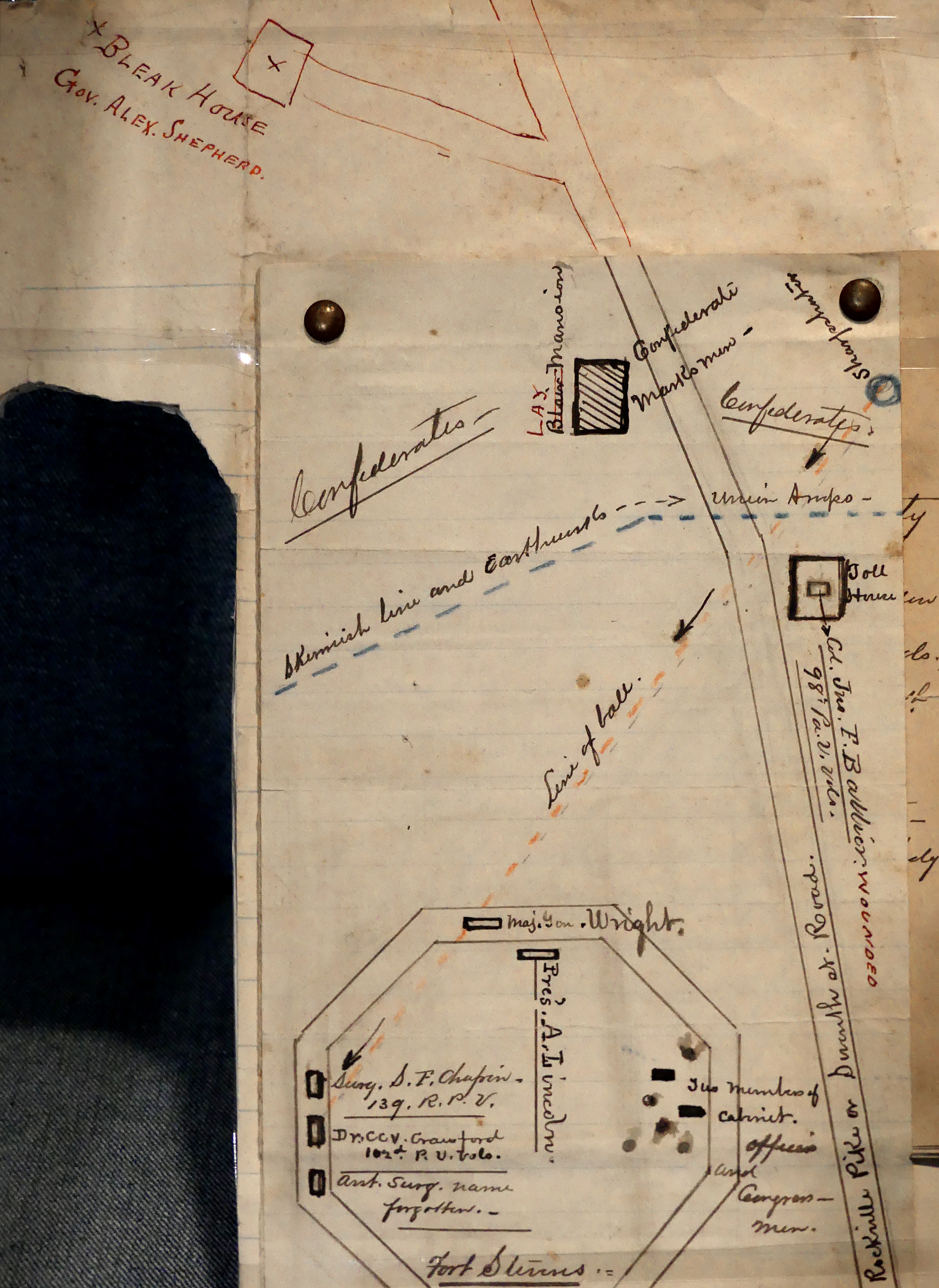
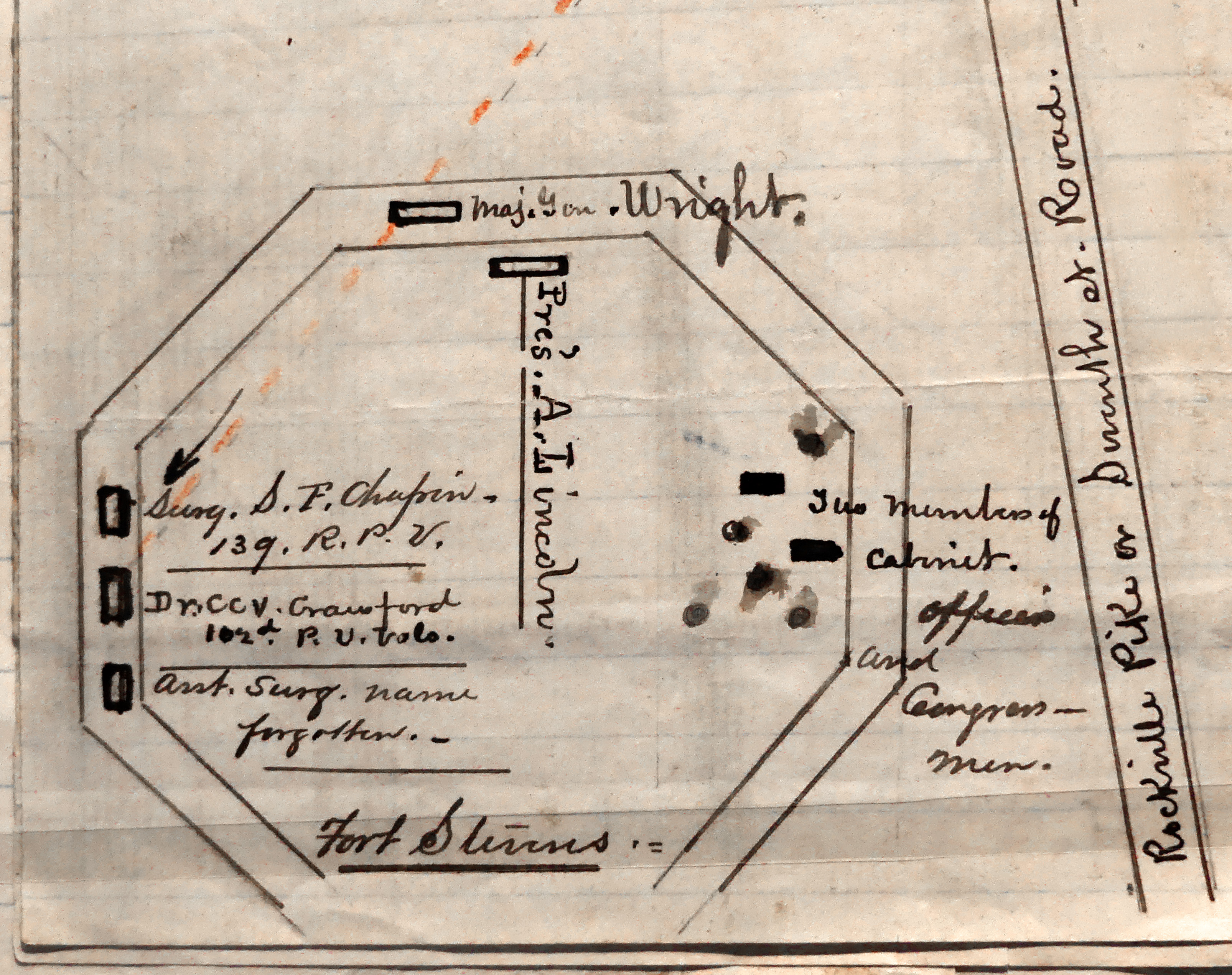
Surgeon Cornelius V. Crawford describes his wounding on July 12, 1864 while standing near President Lincoln of the ramparts of Fort Stevens and includes a map/diagram of the incident.
Lewis C. White:
My dear Sir and Comrade:
A soldier's earnest, hearty greeting to you, my old Comrade of the War of the Rebellion, and fellow member of the gallant 102n Pa. V. Vols., of the ever memorable old fighting 6th Corps of the Army of the Potomac.
I have received your letter, seeking information you desire to embody in a prospective work setting forth in enduring type an account of the battle of “Fort Stevens”, defenses of Washington,D.C.
With more than ordinary pleasure, I hasten to respond to your letter of inquiry, and give you the facts, which are indelibly impressed upon my mind and memory.
In the forenoon of July 12, 1864, Major Gen. Wright, Commanding the 6th A. O., having made such disposition of his forces as seemed desirable to him, rode into Washington, some five miles away, to pay his respects to the President and Secretary of War. Fighting continued more or less actively during the day, but owing to the forces in our immediate front, and untiring activity of a considerable body of sharpshooters occupying Lay Mansion, who picked off nearly every man who raised above the breastworks of earth that had been hastily thrown up, little of a satisfactory character was accomplished. In the neighborhood of five o'clock, P. M., General Wright, accompanied by President Lincoln, several cabinet officers, members of Congress, Mrs. Lincoln and several lady friends, returned to the Fort. After investigating the state of affairs, which was not to his satisfaction, he determined to shell the Lay Mansion, with the view of driving out the large body of sharpshooters, who had so greatly annoyed our line during the day, having, during the forenoon, severely wounded in the right thigh Colonel Ballier of the 98th R. P. Vol.s., commanding the skirmish line and who was sitting in the toll house, his temporary headquarters.
Having dispatched his orders to the skirmish line to deploy right and left, and lie down until after the bombardment and then reform and charge the enemy, Major Gen. Wright, who was dressed in the full uniform of his rank, laid down upon the front parapet of the Fort, reclining upon his left side, head resting in left hand, face to the enemy and his field glass held in his right hand resting upon his right hip. President Lincoln stood within the Fort, directly back of Wright, his unusual height permitting a fair view of the movements in front. On the side parapet of the Fort left of front, stood side by side, as shown in the accompanying diagram, Surgeon Chapin, 139 r. 'p.' v. '. Crawford 102d regt. P. V. V. and a young medical officer (name forgotten), of I think, the 93rd R. P. V. The sun's rays falling full upon Major Gen. Wright's belt and equipments, revealed at once to a sharpshooter upon our right, armed with an English telescope rifle, the prize awaiting his deadly missile, and so clear was the bead he drew upon him that the large canonical ball passed between Wright's forearm and arm. The scream of such a ball as it rapidly pierces the air, so well known to any old soldier, and its dangerously close proximity, impelled the President to involuntarily diminish the height of his personage, which he did by suddenly crooking his knees, whilst Wright, not standing upon the order of his movement, quickly turned and rolled upon the sward inside the fortification. The dull “chuck” quickly following the scream indicated very plainly the fact that some unlucky one had made too close an acquaintance with the unwelcome visitor.
Surgeon Chapin was the first to speak, and ascertained that I had been struck, he and my young German friend quickly sprang for the parapet whilst I sat down upon it, facing inward. Having informed him as to the location of the wound, he quickly opened his pocket knife, and without ceremony, cut from top to bottom a valuable pair of riding boots, pants and under garment, shook his head ominously and just as the two were about to lift me inside the fort, a second deadly missile, evidently from the same source, barely missed my head. I was carried into the hospital building, and singularly enough, to the identical table upon which I had that day operated upon a number of other poor victims until about 4 o'clock. Positively refusing to take an anaesthetic, Surgeon Chapin, using his two little fingers as probes, bored his way through form wound of entrance and exit, giving the horrible sensation of two live coals being passed through the limb. The crust of the Fibia had been carried away and a ragged, ugly wound made by the bullet, which I still have and which is cut almost as smoothly as though by a knife, from its impact against the hard crust of the bone. Refusing all operative procedure, I was kept until nearly ten o'clock P. M., by which time a train of wounded had been made up for Washington City. I was assigned to “Mount Pleasant” Hospital, arriving sometime after 12 O'clock, M. After nine days of treatment there, during which time erysipelas and gangrene developed, I secured a furlough, and returning home, suffered severely, spending more than five weary months in bed and on crutches. Seven senises were opened, and some sixteen pieces of dead bone removed, before the wound finally closed. Since then, it has reopened repeatedly, a very slight blow over the wound, such as would scarcely be noticed elsewhere, causing it to inflame and open afresh.
I trust the above account, together with the diagram accompanying, will afford you all necessary data required for your book.
And now, in reply to your specific queries, permit me to say:
- Shot July 12, 1864 at 5:30 P. M.
- Mr. Lincoln was within a few feet of me when wounded.
- I stood upon the parapet when shot.
- Mrs. Lincoln and accompanying lady friends were not permitted to enter the fort, but sat outside in the carriages which brought them from Washington.
- Dr. Roberts did not dress my wound or in any way minister to my necessities. Dr. Chapin did what was done prior to my removal to the hospital.
- I have no knowledge of Mrs. Lincoln fainting and very much doubt if she did. Of course, the news of my wounded condition rapidly spread, but at no time did she see the wound, not having been permitted to enter the fortification, in view of possible danger, and the outcome showed the wisdom of the commanding officer.
- I believe Mrs. Lincoln grew faint and sick when she heard I had been shot, simply I think, as the result of physical fear, and I believe Mr. Lincoln attempted to rally her energies by telling her “She would not make a good soldier, if she grew faint at the first sight of blood or scream of bullet.” Her only reply was &ldquolBut dear, suppose it had been you instead of Suregon Crawford?”
- All the parties came in large open carriages, the day being beautifully clear and warm. General Wright, Mr. Lincoln, two cabinet officers, several Congressmen and Army Officers came within the fort. None of the ladies were permitted inside, but sat in the carriages that brought them from Washington.
And now, my dear Comrade, the facts, as far as stated, are correct, and rest not only upon memory, but have been verified by careful reference to letters written my wife at the time these occurrences happened, and as she has carefully preserved all my Army with great care, I am glad to give you the solid facts in the matter.
If you sent me a circular, etc. prior to the one received in this morning's mail, it must have gone astray. I shall be pleased to see your prospectus, and of course, when the work is completed, shall want several copies of it.
Hoping the work will be full, thorough and historically correct, and wishing you very large success and both in fame and pecuniarily, I am, very sincerely in F. C. and L.
Yours
(Signed)
Cornelius C.V.Crawford;
Chester Heights
Delaware, Co.,
Pa.
Sept. 17, 1900.
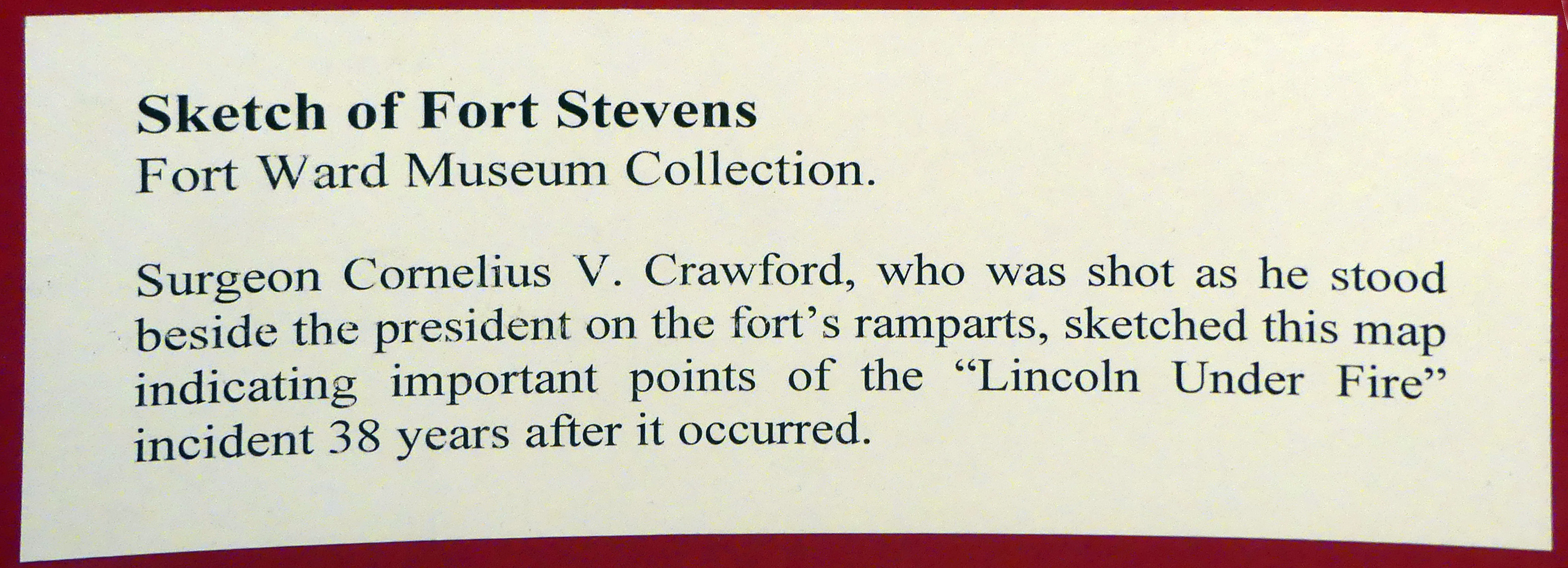
Crawford's diagram of the July 12, 1864 incident in which Crawford was wounded and President Lincoln came under enemy fire can be found in the Fort Ward Museum in Arlington, Virginia:
A PDF of Cornelius V. Crawford's letter to Lewis Cass White is available in Alexandria's Lewis Cass White Collection. The accompanying diagram was photographed, by ACB, at the Fort Ward Museum in Arlington Virginia. The Lewis Cass White Collection comments on a photo of Crawford's diagram.
 |
 |
 |
 |