By EDWIN B. HAY.
IF handwriting is a “gesture of the mind,” great minds should be capable of extraordinary “gestures.” Cabinets, evidently, are not selected for handwriting, as is apparent in the President's official family at the present time. Thinkers have always been to busy making thought to bestow attention upon the method or expressing it in writing. So the art, itself, of chirography has received little attention from the student of the higher professions.
It was said of Horace Greeley that he could not read his copy for editorials, and rewrote often times sentences that he could not translate, though written by himself. The elder Choate also enjoyed the reputation of possessing the faculty of using unintelligible characters in his writing.
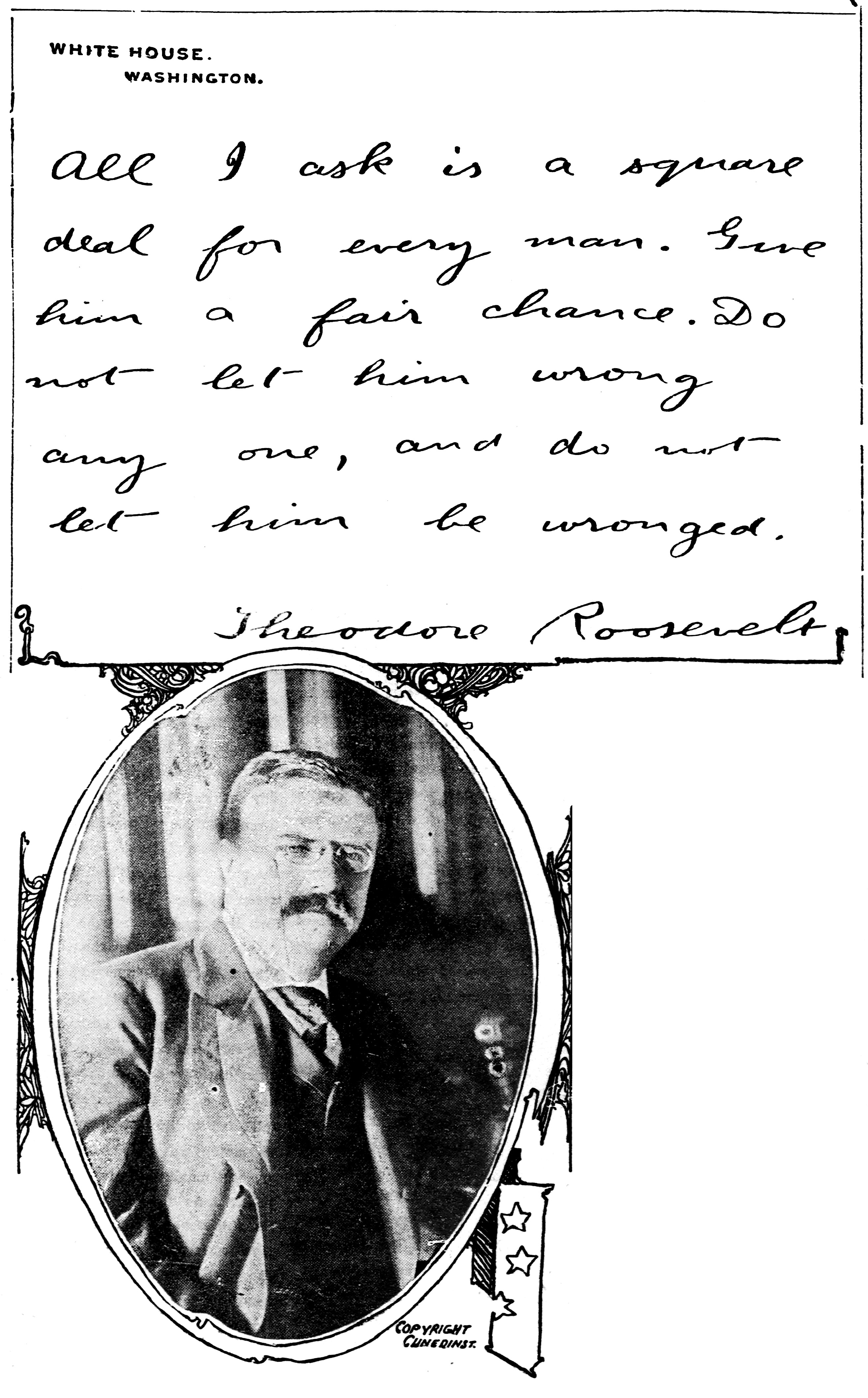
President Roosevelt himself writes very plainly, but in an uncultivated and student hand, which compares more with that of Andrew Johnson than almost that of any other President.
It may be said without doubt that Mr. Roosevelt is the most versatile, most accomplished, most scholarly and the most mercurous of Presidents, but it is easily to be observed that handwriting was never intended to be one of his accomplishments. His signature itself would be a disappointment to those who would expect something greater from a man in a great position.
It is not to the thing said in the above exhibit of script that this glance is direeted, but to the script itself, as the expression, &lduqo;a square deal for every man,” will live in the minds of American people long after the hand that penned it is stilled forever. The handwriting possesses individuality; that must be admitted. But it shows neither strength nor beauty. It is simply plain writing, and very plain at that. It has no pretension to being anything more than the means of expressing thought. It has nothing of statesmanship about it, and being without cultivation, savors purely of the hoi polloi. Yet who would not love to have a real signature of Theodore Roosevelt, even in its plainest style, to a certificate of appointment to some official position?
General Grant made a strong signature, but among the Presidents James A. Garfield was the best penman that ever executed the signature of President, and his handwriting was a wide departure from that of Mr. Roosevelt. John Hay wrote somewhat like Mr. Lincoln.

The Cabinet Scrawls
Our present Cabinet is composed of men of thought and action, and so capable are they of coping with the various trying topics of the day, pertaining to national affairs, that it would be impossible for the graphologist to read the character of any one of them by his handwriting.
Knowing each of them personally, as I do, and being familiar with the pleasant features and some of the personal characteristics of the individuals, it would not be to my purpose to judge either of them by the combination of lines and spacings, and joinings in the formation of letters that make up either signature or script work. None of them excels in the art of handwriting.
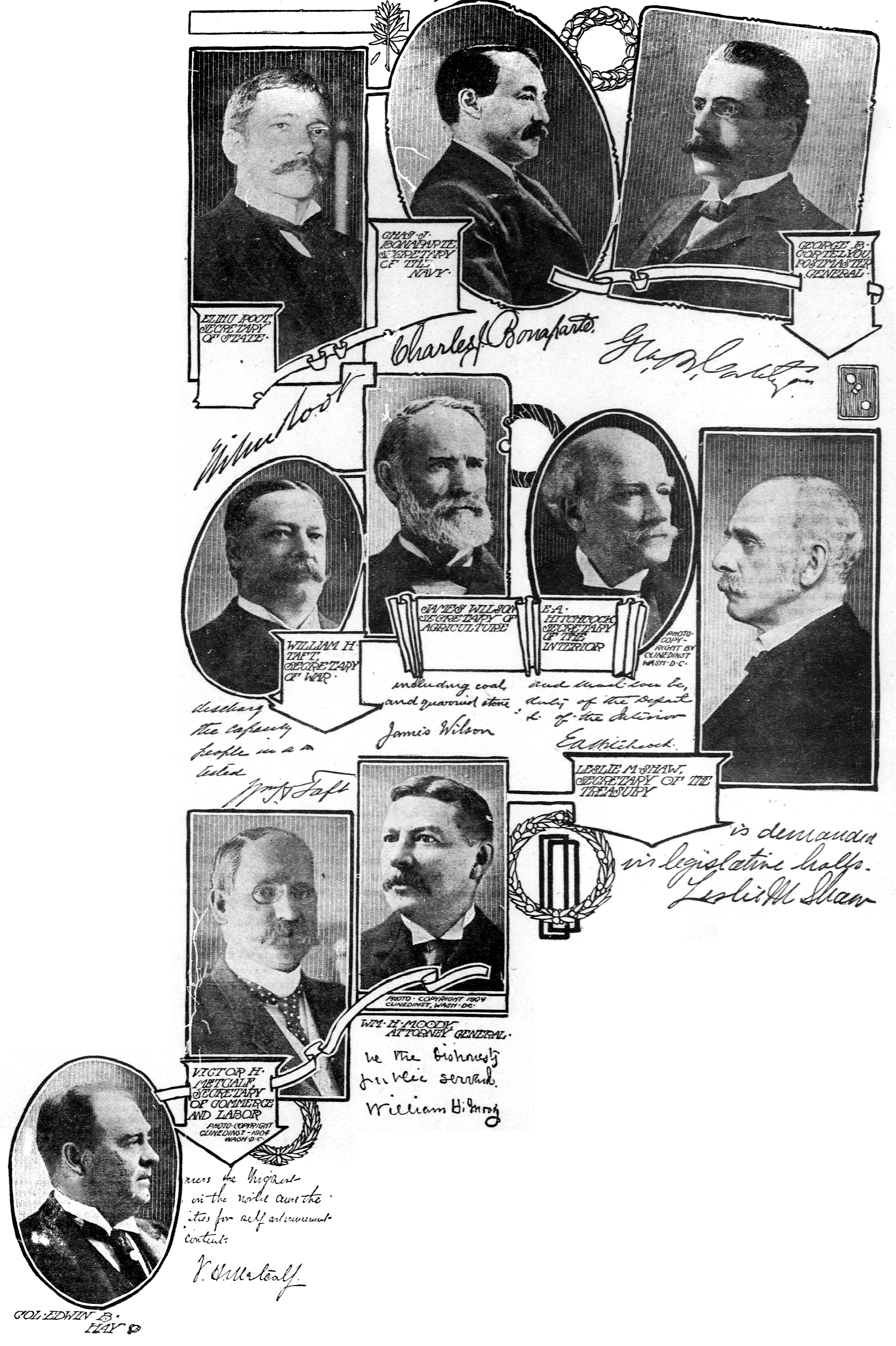
The strongest, most uniform, and smoothest work, is that of Mr. Taft, who, when in comparison with his Cabinet brothers, might be called the “King of the Quill.”
Next in order of uniformity and strength of stroke is that of Mr. Root, whose hand is given to the angular system, though it is not as clearly defined as the writing of his brothers in the Cabinet.
The hand that swings the cradle and guides the plow would never be expected to be very marked in its guiding of the pen, therefore we would not look for perfection in the handwriting of Mr. Wilson, which is so uncultivated that it resembles Mr. Roosevelt's, though it is much smaller and more compact. Mr. Roosevelt possesses the habit of liberal spacing between words.
The handwriting of Mr. Metcalf and Mr. Hitchcock resemble very much in style, in that it is small and rather effeminate in its execution. Mr. Metcalf is the more concise and deliberate of the two.
Mr. Moody has a style peculiarly his own. It is a backward slant and differs from the others in this regard. It is not connected and is broken in its strokes; plain, but easily read, and in the shade of the strokes to the right indicates a pressure of movement in that direction by a stub or blunt point pen.
Shaw's Hand Characteristic.
Mr. Shaw writes freely and smoothly, after a style that might be easily accepted as that of a woman's hand taught in the school of exaggerated or large writing. His is the most pronounced characteristic work of all the family.
Mr. Bonaparte's signature, while plainly written, is not especially characteristic of anything. It is the youthful hand and evidently has never changed from the time when he first settled into that style of signature as a boy at school.
Mr. Cortelyou's is the most undefinable of all the signatures. He is a hasty writer, a style cultivated by him, no doubt, in his stenography, which has been to him of such great service.
None of the signatures show any evidence of age or infirmity of any kind, but exhibit steadiness of nerve, strength of physique and control of hand, which should dispel any idea of a wavering in determination.
Thus we find in this coterle of the most distinguished men in the country today a marked variety of handwriting, which indlcates nothing more than the fact that each of these gentlemen, when the hand was being formed, was educated in schools far apart, where different systems were taught, or in which there were no systems at all so that in the handwriting, like Topsy, they “was not borned, but jist growed.”
What Would You Think?
Could the Oracle of Graphology gaze upon the signature of Mr. Taft and define his make up as a man? Could he see in it a genial nature, a winning personal magnetism, a rotund form, bubbling over with happiness? Could he hear the infectious laugh that sets surrounding space in the motion of gladsomeness?
Could he find in “Leslie M. Shaw” a spirit of homely manliness that captures all who come in contact with him? Could he personify optimism in that hand and exclaim, “Behold Shaw!” Could he find in “James Wilson” a fatherly instinct to inspire the expression, “Bless you, my boy, how's your crops?” with the presence of the kindly nature and a gentle disposition, that naturally must accompany such a greeting?
Does “Elihu Root” exhibit in its execution the power of mentality back of it, with a bit of coldness in the strokes that would indicate a want of warmth in the writer? Does the disjoining of strokes in the Moody writing, indicate any disjoining in the makeup of the individual, or show any weakness in any of his opinions?
Does the distorting of Cortelyou's signature indicate any distortion in the clean cut individual? So this glance at the official family chirography is but a passing comment upon the variety of style, which being crude in its way indicates not in the least any want whatsoever of strength in the mental caliber that gives to the President much of his courage in coping with the varied subjects at home and abroad that naturally occupy the attention of himself and his chosen advisors.