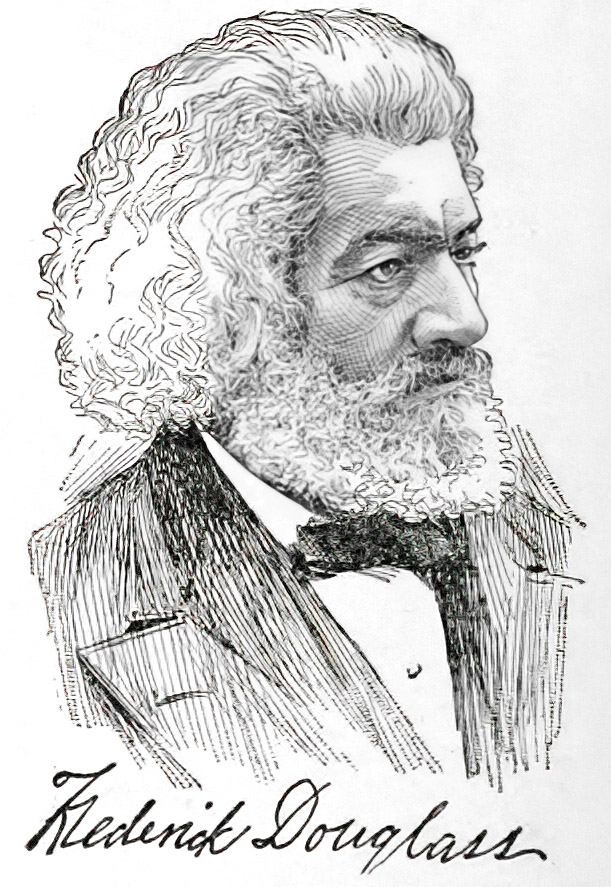
DOUGLASS, Frederick, reformer, was born in Tuckahoe. Talbot county, near Easton, Md., about February, 1817; a slave to Aaron Anthony on the plantation of Col. Edward Lloyd. His mother was a mulatto and his father white. He learned to read and write when nine years old while with Sophia Auld of Baltimore, a relative of his master. He was afterward put at work in the shipyard of his master's brother, Hugh Anthony, and was later sent to the farm of Edward Covey, who frequently severely chastised him for writing passes for slaves, until he resented the indignity and resisted further similar attempts.
Soon after this, with three other slaves, he formed a plot to escape, but was arrested and put up for sale. His master relented and sent him to Baltimore, where he was again employed in Hugh Anthony's shipyard. He escaped from servitude. Sept. 2, 1838, went to the city of New York, where he was married to Anna Murray, a free colored woman, and immediately removed with his wife to New Bedford, Mass., where he obtained a livelihood by working in the shipyards and on the docks. To conceal his identity he changed his name from that of his master, to Douglass. At an anti-slavery convention in Nantucket in 1841, he made his first public speech, which procured for him the appointment as agent of tne Massachusetts, Rhode Island and American anti-slavery societies. He occupied the next four years in travelling and lecturing throughout New England and the northern middle states. His personality and eloquence attracted large audiences and the publication of his “Narrative” enhanced the interest with which he was regarded. The increasing danger of recapture, however, determined him to go to Great Britain, where he also addressed crowded houses and awakened great enthusiasm. His friends, Mrs. and Miss Richardson of Newcastle-on-Tyne, lawfully manumitted him, paying £150 as his ransom to his former master. He returned to America in 1847, settled in Rochester, N.Y., and there established the North Star, afterward changing its name to Frederick Douglass's Paper. In 1859, when Governor Wise of Virginia, supposing Mr. Douglass to be in Michigan, made a requisition on the governor of that state for his arrest, charging him with implication in the John Brown raid, he fled to England, but after several months returned to Rochester, N.Y., and continued to publish his newspaper. He urged upon President Lincoln the employment of the negroes as soldiers, and the proclamation of emancipation as a war measure. In 1863 he helped to enlist men into the colored regiments and especially aided in the organization of the 54th and 55th Massachusetts, in which his sons, Lewis and Charles, were volunteers. He discontinued his paper when emancipation was accomplished, and devoted himself to the lecture platform. He established the New National Era, Washington, D.C., in 1870, and in 1871 went to San Domingo as assistant secretary of the commission composed of Senator Wade, Dr. S. J. Howe and President Andrew D. White, sent to that island to report on the condition of affairs with a view to annexation to the United States. Meanwhile his sons, Lewis and Frederick, continued the newspaper. He was one of the territorial council of the District of Columbia by appointment of President Grant, and in 1873 was presidential elector-at-large for the state of New York and was delegated to carry the official vote to the national capital. In 1877 he was appointed by President Hayes U.S. marshal for the District of Columbia, and this appointment created a profound sensation, as he was the first colored man in the history of the nation to be so honored. In 1881 he was appointed by President Garfield recorder of deeds for the district. In 1886 he went abroad, extending his travels to Egypt and Greece, and on his return in 1889, was appointed by President Hayes U.S. minister to Hayti and chargé d'affaires to San Domingo. He resigned in 1891, greatly venerated and esteemed by the Haytian republic, which, as a token of its regard, appointed him commissioner of the republic of Hayti at the World's Columbian exposition at Chicago. His wife, Anna Murray, the mother of his five children, died Aug. 4, 1882, and on Jan. 24, 1884, he was married to Helen Pitts of New York state, a white woman of social position and an employee in the office of recorder of deeds, Washington, D.C. Their marriage was the occasion of severe criticism by individuals of both the white and the negro race, but the result they anticipated did not follow, and Mr. Douglass steadily gained in his ascendancy as leader till the end of his life. His published works include: Narrative of My Experience in Slavery (1844); My Bondage and My Freedom (1855); and Life and Times of Frederick Douglass (1881; rev. ed., 1893). He died suddenly at his home, Cedar Hill, Anacostia, D.C, Feb. 20. 1895.