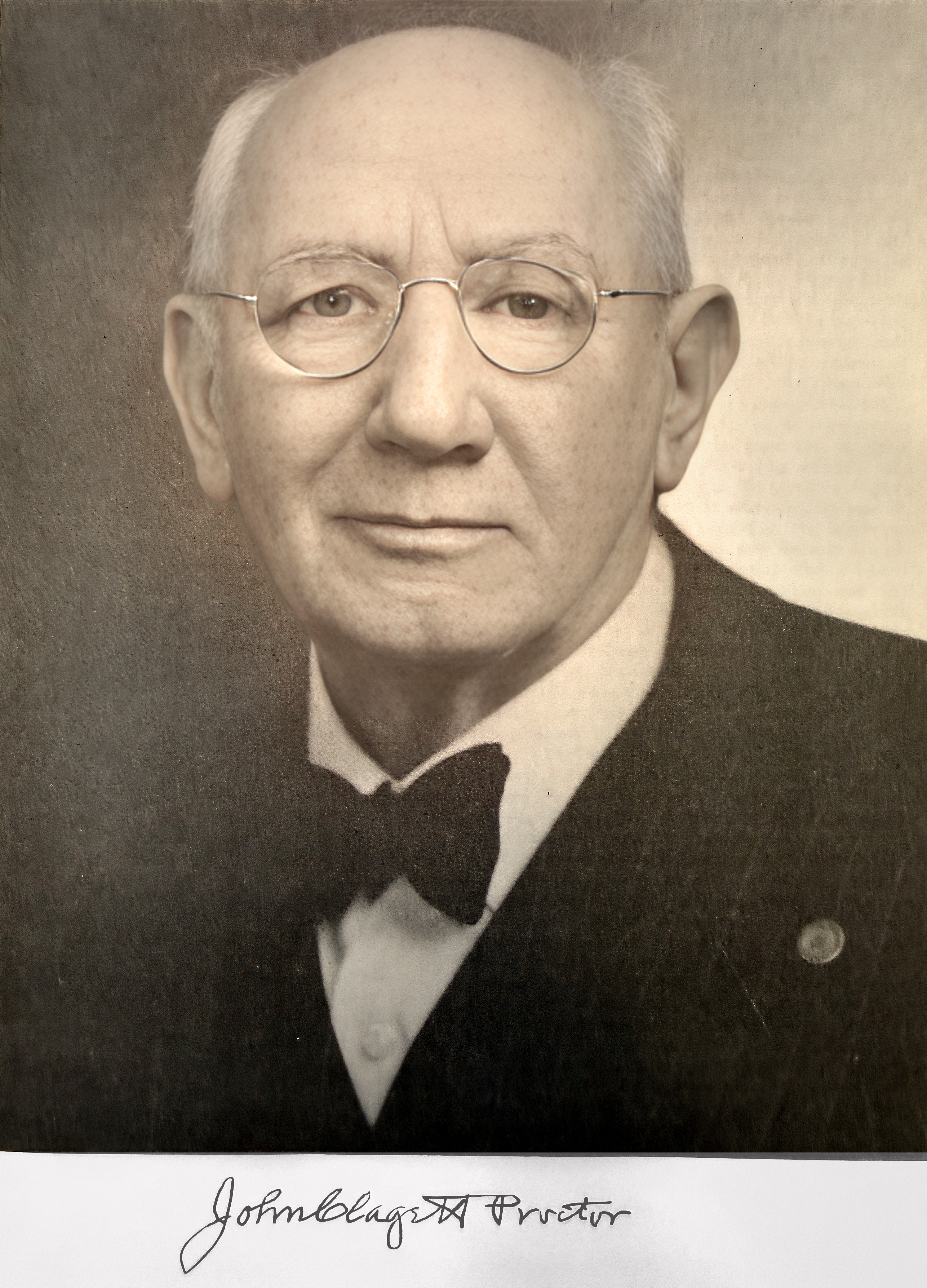
John Clagett Proctor, LL.D.
AUTOBIOGRAPHY
John Clagett Proctor, historian, poet, genealogist and writer, son of John Clagett Proctor, newspaper editor, and Mary Ann (Davison) Proctor, was born on the north side of New York avenue, between Sixth and Seventh streets, in Washington. District of Columbia. November 15, 1867, and educated in the public and private schools of his native city, and in the National University Law School, from which he graduated in 1893 with the degree of Bachelor of Laws, and postgraduated in 1894, receiving the higher degree of Master of Laws, and was admitted to practice before the bar of the Supreme Court of the District of Columbia the same year. Later, on June 13. 1939, he received the degree of Doctor of Laws causa honoris from the same University for his conspicuous services to the National Capital as one of its foremost historians and for his patriotic and generous contributions to the civic welfare of the District of Columbia.
At the time of the birth of the author, his father, for whom he was named, was the city editor of the National Republican, having resigned his position as reporter on the Evening Star, on January 20, 1865, with the regrets of the editor of The Star, Crosby S. Noyes. It was shortly after this that he reported for the Republican the famous Surratt and Wirz trials. Later, at the time of the birth of the writer, one of the reporters on the Republican named “Bucky” Taylor, slipped into the paper of November 16, 1867, the following verses:
“Our chief reporter, Johnny C., Last eve was absent after tea; Said all: ‘What can the matter be?’ “This morn, the wonder came to light He found an ‘item’ home last night, Which he reports - ‘A boy! all right!’ “That's what's the matter!”
Prior to this, the senior Mr. Proctor, during the early Civil War days, served as a reporter on the staff of the Philadelphia Public Ledger, and in September, 1867, was elected first president of the Washington Press Club, and was the managing editor of the Daily Critic at the time of his death. July 12. 1816.
When still in his teens, the subject of this sketch entered his apprenticeship in the United States National Museum printing office, in 1883, leaving there shortly afterward for outside employment, including such printing offices as R.O. Polkinhorn, John Herrmann, and with Maurice Joyce, the stereotyper and engraver. Following this he returned to the National Museum on July 21. 1884, where he was placed in charge of the office in the spring of 1888, and continued in charge until February 28, 1931, when, at his own request, he was retired. During the meantime, from November 3, 1906 to 1931, the Museum printing office was under the direction of the Government Printing Office. However, it was on October 2. 1906, that he set the type for the electrotype plates placed in the new Museum building corner-stone. But it was the contact with the Smithsonian Institution and its historical collections that developed in him a love for history and genealogy, in which he has been actively interested from his earliest association with the Institution, and which materially aided him as a writer for The Sunday Star, from 1928 to the present time. During the time he served under the Institution, the secretaries included Professor Spencer F. Baird. Dr. Samuel P. Langley, Dr. Charles D. Walcott. and Pr. Charles G. Abbot. Upon leaving the Smithsonian, Mr. proctor was given the privileges of the Institution's library, at his request. And, at the same time, under date of February 28. 1931, Public Printer George H. Carter said in part: “That we extend to our retiring colleague the heartfelt wish of the employees and officials of this office for the full and lasting enjoyment of the fruits of his labor and the blessing of years of unalloyed happiness and good health.”
Prior to this, in 1927, he was engaged by the Lewis Historical Publishing Company, Inc. as editor-in-chief for a five-volume history of the District of Columbia, two volumes being historical and three volumes biographical. This work was issued under date of 1930.
As a basic foundation for his life's work, the author has also to his credit many pamphlets and booklets on historic sites of the District of Columbia from 1902 to date, and on Aril 6. 1910, he was appointed a member of the Permanent Committee of Marking Points of Historical Interest, the committee being revived in 1921 by Cuno H. Randolph, president of the board of Commissioners, District of Columbia, and later continued by Commissioner Melvin C. Hazen. Also from the inauguration of Theodore Roosevelt he prepared the historic sites booklets, and was chairman of the Historic Sites committee for the inaugurations of Calvin Coolidge and President Harry S. Truman.
As to the organizations,the biographer is affiliated with, he has in mind Federal Lodge, No.1. F.A.A.M. He having been a Master mason since October 5. 1893. In 1903 he joined Mizpah Chapter, O.E.S., and became its worthy patron in 1907, and together with Mrs. Proctor they were the principal organizers of William F. Hunt Clapter No. 16, also of this body. later, in 1929. he became Grand Patron of the Order. In 1902 he was appointed a member of the committee for the Society of the American Association for the Advancement of Sciences.
On March 27. 1920, be attended the preliminary meeting for the forming of the Society of Natives, in the Board Room of the District Building. The idea for the forming of the Society being attributed to Mrs. Johan C. Kondrup. Subsequent1y, on April 11, officers were elected and the writer of these notes was elected the Society's second president on November 21, 1924. His membership in the Association of the Oldest Inhabitants dates from January 1, 1918, and of which he became vice president in 1923. Subsequently he acted as president in the absence of President Theordore W. Noyes, at that officer's request, and for that association he wrote many stories, as reported at the time in The Evening Star. And when Mr. Shannon (“The Rambler”) was unable to further carry on with his historical writings, it was Noyes who personally, and in the presence of the writer, directed the then managing editor to turn over the “Rambler's” work to the present scribe.
Subsequently it was this individual who was responsible for getting Mr. Noyes reluctent consent to agree to have his friends tender him a dinner on the eightieth anniversary of his birth, January 26, 1938, at the Willard Hotel, and where upon this occasion, was assembled one of the most distinguished gatherings of friends of this notable editor ever brought together in the Federal Capital, or any similar occasion.
During President Coolidge's administration, the writer read at the Arlington National Cemetery upon several occasions, poems appropriate to the occasion, and as a member of the Sons of Union Veterans of the Civil War, he also, from 1906 on, assisted in the Memorial Day exercises at Battle Ground National Cemetery, where his poems were a feature of the program and where for many years he was in charge and presided over the gathering. On August 2, 1945 he was given a Citation by the American Legion of the District of Columbia, at the Mayflower Hotel.
Since 1919 the writer has been a member of the Columbia Historical Society, and has contributed a number of interesting articles for its records, and he was its chronicler from 1930 to 1944. He was also for many years a member of the National Association of Retired Federal Employes, of which he served as first vice president and as editor of The Annuitant. He is also a member of the Brightwood Citizens' Association, having joined this body in 1905, serving from time to time as vice president, secretary and delegate to the Federation of Citizens' Associations. He is also a member of the Shepherd Park Citizens' , Association and at an earlier date, from 1925 on, did broadcasting over stations WRC, and WMAL. Other bodies of which he is a member include the Columbia Typographical Union, 101, which he joined in March, 1903; Washington Board of Trade, Young Men's Christian Association; Masonic Veteran Association. The Evening Star Club, The Trestleboard Club, Alumni Association of the National University, Sons of the American Revolution since 1911.
Besides this, he delivered numerous lectures and addresses for local societies and bodies on historic subjects.
As to his poems, many of these have appeared from time to time in the Washington Evening Star, and in other local newspapers.
John Clagett Proctor, born in 1867, was married to Annie Maud Crown, daughter of Charles E. and Francis Marion (Haislett) Crown, on October 5, 1887, at the home of the bride's parents, at the southwest corner of what was then Messmore avenue and Huron street, Meridian Hill, by the Rev. Samuel Hansel Giesy, rector of the Church of the Epiphany, before a goodly number of guests; the best man being Frederick C. Philpitt, who acted also as witness, and Maggie C. Balderston, a witness as well as the bride's cousin. The newly-married couple, within a month, went to reside in their home at 1648 Huron street, northwest, where their children, Francis Edward and Maud S. were born.
After a married life of fifty years, Dr. and Mrs. Proctor celebrated their Golden Wedding on October 5, 1937, at their home 1605 Jonquil street, northwest, before a large gathering, and again, ten years later, they celebrated their Sixtieth Anniversary, with clergy present, upon both occasions, from Epiphany Church.
Mrs. Proctor who has encouraged her husband in his work, has distinguished Colonial and American Revolution ancestry that admitted her to the Society of the Daughters of the American Revolution. And it was her great-grandfather, William Cadle, on her mother's side, who died in 1814, from wounds received in defending Fort McHenry, and the flag, September 13 and 14, 1814. It was this gallant defense, made by the soldiers of Fort McHenry, that inspired Francis Scott Key to write “The Star-Spangled Banner.”
Autobiography, Proctor's Washington and Environs, 1949, by John Clagett Proctor. (PDF)
This Autobiography, and photo also appeared in Proctor's Poems, 1950, by John Clagett Proctor.