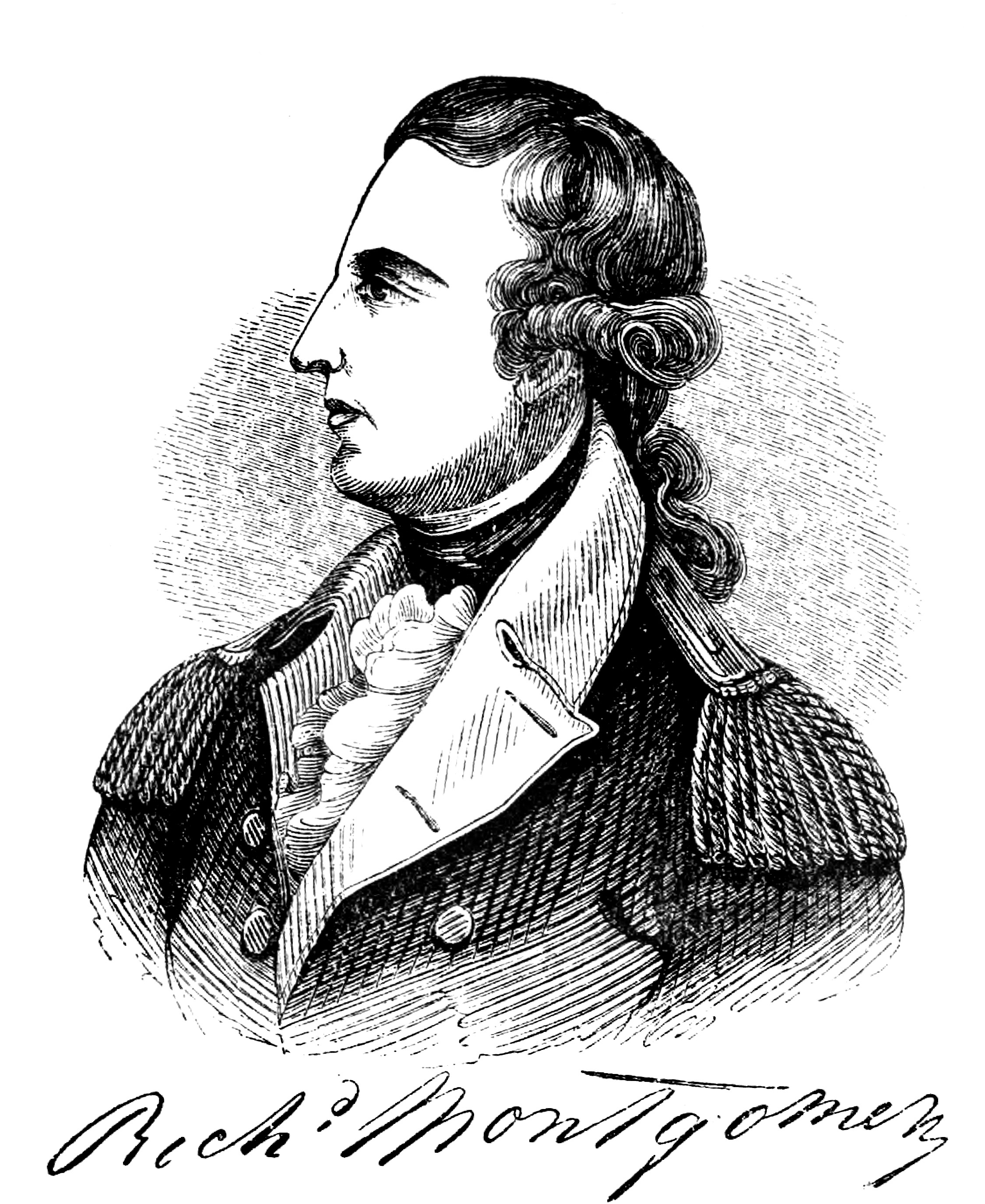
3Richard Montgomery was born in the north of Ireland in 1737. He entered the army at the age of twenty, and was with Wolfe at the storming of Quebec in 1759. He was in the campaign against the Spanish West Indies, and afterward resided some time in this country. He quitted his regiment on his return to England in 1772. While here he imbibed an attachment for the country, and returned to make it his home. He purchased an estate upon the Hudson, in Rhinebeck, Dutchess county, and married the daughter of Robert R. Livingston. When the Revolution broke out, he espoused the cause of the colonists, and in the autumn of 1775 was second in command, under Schuyler, in the expedition against Canada, with the rank of brigadier. The illness of Schuyler caused the chief command to devolve upon Montgomery, and in the capture of St. John's, Chambly, and Montreal, and his attack on Quebec, he exhibited great judgment and military skill. He was commissioned a major general before he reached Quebec. In that campaign he had every difficulty to contend with — undisciplined and mutinous troops, scarcity of provisions and ammunition, want of heavy artillery, lack of clothing, the rigor of winter, and desertions of whole companies. Yet he pressed onward, and, in all probability, had his life been spared, would have entered Quebec in triumph. His death was a great public calamity, and throughout the land public honors were paid to his memory. The eloquence of Chatham, Burke, and Barré sounded his praises upon the floor of the British Parliament, and the prime minister (Lord North), while acknowledging his worth, and reprobating the cause in which he fell, concluded by saying, “Curse on his virtues, they have undone his country.” As soon as the news of his death reached Congress, resolutions of condolence with his family for their bereavement, and expressive of their “grateful remembrance, profound respect, and high veneration,” were adopted. It was voted to erect a monument to his memory, which was accordingly done, in the front of St. Paul's Church in New York city, on which is the following inscription:
This monument is erected by order of Congress, 25th of January, 1776, to transmit to posterity a grateful remem- brance of the patriotic conduct, enterprise, and perseverance of Major-general Richard Montgomery, who, after a series of success amid the most discour- aging difficulties, Fell in the attack on Quebec, 31st December, 1775, aged 37 years.
In 1818 a request in behalf of the widow of General Montgomery was made to the Governor-in-chief of Canada, Sir John Sherbrooke, to allow his remains to be disinterred and conveyed to New York.
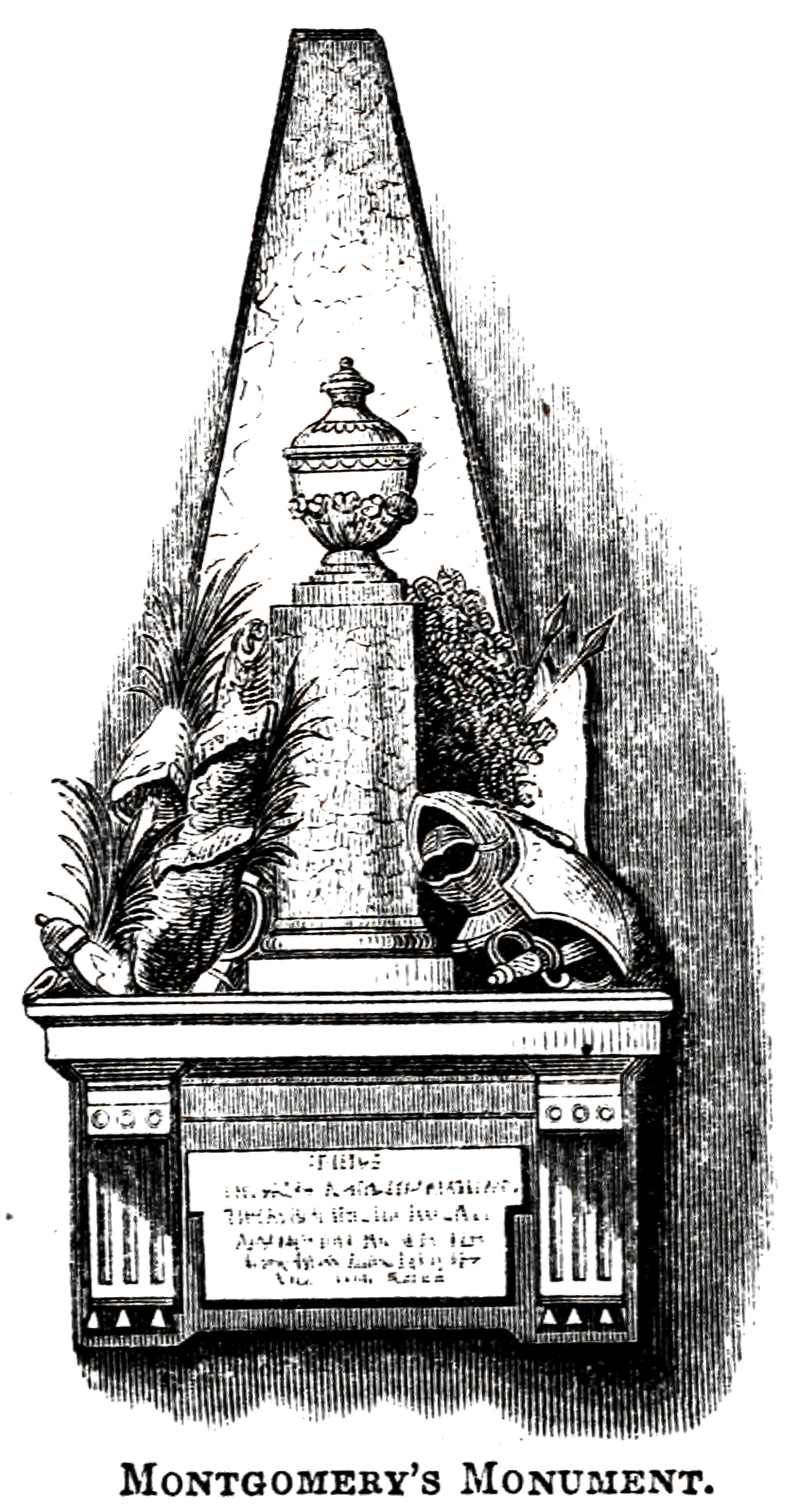 The request was readily acceded to, and Mr. James Thompson, of Quebec, who was one of the engineers at the time of the storming of the city, and assisted in burying the general, also assisted in the disinterment, making an affidavit to the identity of the body. He said, in his affidavit, that the body was taken to the house of Mr. Gobert, and placed in a coffin lined with flannel and covered with black cloth; that Rev. Mr. de Montmolin, chaplain to the garrison, performed the funeral service; that Montgomery's aids (M'Pherson and Cheeseman) were buried in their clothes, without coffins; and that he (Thompson) afterward wore Montgomery's sword, but the American prisoners were so affected by the sight of it, that he laid it aside. He identified the coffin taken up on the 16th of June, 1818, as the one. The remains were placed in another coffin and deposited beneath the monument. The following is the inscription upon a silver plate on the coffin: &;ldquo;The state of New York, in honor of General Richard Montgomery, who fell gloriously fighting for the independence and liberty of the United States before the walls of Quebec, the 31st of December, 1775, caused these remains of the distinguished hero to be conveyed from Quebec, and deposited, on the 8th day of July (1818), in St. Paul's Church, in the city of New York, near the monument erected to his memory by the United States.”
General Montgomery left no children whom “the state, in gratitude toward their father, distinguished with every mark of kindness and protection,” as Botta asserts. His widow survived him more than half a century. When at the house of his brother-in-law, the late Peter R. Livingston, at Rhinebeck, a few years ago, I saw an interesting memento of the lamented general. A day or two before he left home to join the army under Schuyler, he was walking on the lawn in the rear of his brother-in-law's mansion with the owner, and as they came near the house. Montgomery stuck a willow twig in the ground, and said, “Peter, let that grow to remember me by.” It did grow, and is now a willow with a trunk at least ten feet in circumference.