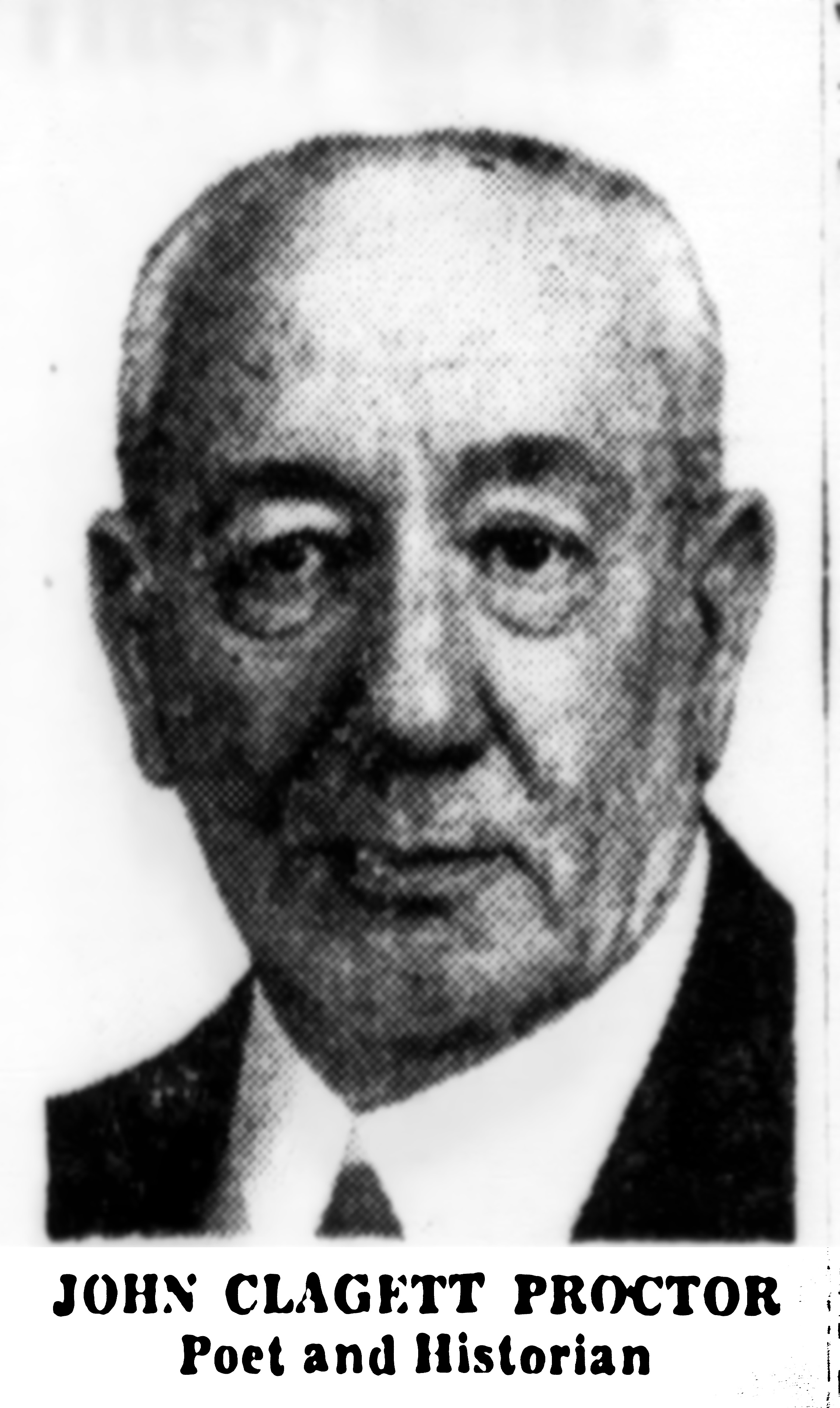
Poet and Historian
John Clagett Proctor, 88, Poet and historical writer for The Star, died last night at his home, 1605 Jonquil street N.W.. where he had been confined for the past three years as the result of a fall in his home.
By virtue of his many years, his remarkable memory and indefatigable research into the records Mr. Proctor became the outstanding historian on 19th Century Washington.
A little man, slightly bowed in his late years with a border of white hair receding from a balding dome he was a familiar figure for years at patriotic and historical meetings.
His great interests were The Star and the Association of Oldest Inhabitants of the District of Columbia.
Recalled Sectional Names.
For longer than 20 years, his pieces on old Washington appeared in The Sunday Star. He loved to reminisce on the old neighborhoods with the funny names. Cowtown, Swampoodle, and Foggy Bottom and on Brookland, Brightwood, Saul's Addition and Petworth He recalled the old canals, swimming holes in Rock Creek and traced from old maps the course of the Tiber the stream that skirted the Capitol, and still does although in culverts underground.
He had a collection of old street directories and he did a lot of research in the offices of [Page B-12] the Assessor and the Recorder of Deeds to determine where distinguished national figures and Washington citizens lived. His accounts were very accurate in detail and historians and biographers have found his articles in The Star a godsend to their work.
He ran the Oldest Inhabitants for years. This unique organization which meets every monthin the Old Union Engine House at Nineteenth and H streets N.W was founded in 1865. T. W. Noyes, editor of The Star, became president in 1919. Some time before World War II his health prevented his attendance and Mr. Proctor, as first vice president, took over.
Elected President.
When Mr. Noyes died in 1946, Mr. Proctor was unanimously elected president. He used to select topics for discussion—the cable cars on Pennsylvania avenue, the old race tracks in the District, the streams that used to flow into the Potomac from present District streets. He would have the topic typed on a postcard and sent to each member. They would come to the meetings prepared to tell what they remembered.
The best testimony usually came from Mr. Proctor. He would save his for the last and top them all. So graphic were his descriptions that it was difficult to distinguish between what he remembered seeing and what he had been told or read about. His description of President Jefferson crossing the flooded Tiber on his horse to get to the Capitol in 1803, the horse was almost swept away by the volume of the stream, had an eye-witness quality that caused other old timers to ask:
“Were you there, John?”
Married 65 Years.
On October 6. 1947, Mr. and Mrs. Proctor observed their 60th wedding anniversary. They were at home in his comfortable brick house on Jonquil street to more than 100 friends.
On January 24, 1953, she fell in her home and suffered a broken hip. She was taken to the Emergency Hospital. On the next day, Mr. Proctor, then 84, fell in the house and also suffered a broken hip. He was taken to the same hospital. She died there on February 3 from a heart condition to which the fall was a contributing factor. His condition was such that he was not informed immediately of his wife's death. They had been married 65 years.
He returned to the Jonquil street house but he apparently had suffered a stroke and was confined to his bed.
Father a Newspaperman.
Mr. Proctor was born on the north side of New York avenue, between Sixth and Seventh streets N.W., on November 15, 1867 His father, a newspaperman, was working on a story about a meteoric shower at the time.
He was educated in public and private schools here and at the National University Law School, where he took his bachelor's degree in 1893 and his master's degree the following year. In 1939, the university awarded him an honorary degree of doctor of laws.
But Mr. Proctor never practiced law. Instead, he became a printer, going to work for the Smithsonian Institution There he developed his interest in history—an interest that kept him busy, often at his desk until 2 a.m., after his retirement.
Historic Sites Committee.
He served on the Historic Sites Committee of the National Capital from its formation in 1902. In this connection, he prepared many booklets about historic sites.
Because of his work with the committee, the Commissioners, in the late 20s, named him chairman of the Permanent Committee on Marking Points of Historic Interest.
He has held office as chronicler of the Columbia Historical Society, president, chronicler and poet laureate of the Association of Oldest Inhabitants, and chairman of the committee on memorials, relics and archives of the Masonic Veterans' Association.
He served on many inaugural committees. He was chairman of the historic Sites Committee for the inauguration of President Coolidge and vice chairman of that committee for the first inauguration of President Franklin Roosevelt.
On January 22. 1928, he began his weekly feature of historical articles in The Star.
5-Day Job.
He said each of his Sunday articles took five days of research, writing and editing. He got much of his material in libraries, driving his car from one to another. He had never been without a driver's license since 1914.
His workroom at home was a maze of filing cabinets, scrapbooks, books and souvenirs of Washington.
Mr. Proctor was editor-in-chief of the five-volume “Washington—Past and Present,” published in 1932.
Another of his works. “Proctor's Washington and Environs,” published in 1949, was a compilation of articles he wrote for The Sunday Star during the period 1928-1949.
Despite his voluminous historical work, he found time for civic and fraternal affairs.
Helped Found Natives.
He was one of the founders of the Society of Natives in 1920 and served as its president in 1924 and 1925.
For many years, he was vice president of the Brightwood Citizens' Association, chairman of the Fort Stevens Association and vice chairman of the Memorial Day exercises at Battle Ground National Cemetery.
He was of Colonial ancestry and was admitted to membership in the Sons of the American Revolution. He was an ardent supporter of national representation for the District and was a member of the Executive Committee for National Representation.
Fraternal Activities.
Mr. Proctor was an active member of Columbia Typographical Union, No. 101; of Lafayette Lodge. No. 19, Free and Accepted Masons: a past noble grand of Covenent Lodge. No. 13, Independent Order of Odd Fellows; a member of the Order of Eastern Star, and a member of the Trestleboard Club.
He belonged to Old St. Paul's Church. Rock Creek parish.
Mr. Proctor was married to Annie Maude Crown, daughter of Charles E. and Francis Marion Haislett Crown, on October 5, 1887, at the home of the bride's parents, at the southwest corner of what was Messmore avenue and Huron street (now Fuller street), Meridian Hill.
The Rev. Samuel Hansel Giesy, rector of the Church of the Epiphany, officiated. Best man was Frederick C. Philpitt, who acted also as witness. Miss Maggie C. Balderson, another witness, was the bride's cousin. The newly married couple first made their home at 1648 Huron street N.W., where their children, Francis Edward and Maud S. Proctor, were born.
They celebrated their golden wedding anniversary on October 5, 1937, at their Jonquil street home, and 10 years later marked their sixtieth anniversary.
Mrs. Proctor, who encouraged her husband in his work, had American Revolution ancestry that admitted her to the Daughters of the American Revolution. Her great-grandfather, William Cadle, on her mother's side, died in December, 1814, from wounds received in September defending Fort McHenry.
Mr. Proctor is survived by a son, Francis E. Proctor of Newton Village, Md., and a daughter, Mrs. Louis E. Callis.
Services will be held at 2 p.m., Monday in St. Paul's Episcopal Church in Rock Creek Cemetery. Burial will be in Rock Creek Cemetery. The hour of the funeral will be announced later.